

Hims & Hers: Punished for Going Legit

Ticker: NYSE: HIMS
Price (June 2026): ~$28, down roughly 51% from the 52-week high of ~$70
Market Cap: ~$6.4 billion
TTM Revenue: ~$2.4 billion, with FY26 guided to $2.8 to $3.0 billion
Implied Valuation: ~2.9x EV/Sales, below its own history
The Quarter That Looks Like a Collapse
Read the Q1 2026 headline numbers cold and you would think the story is over.
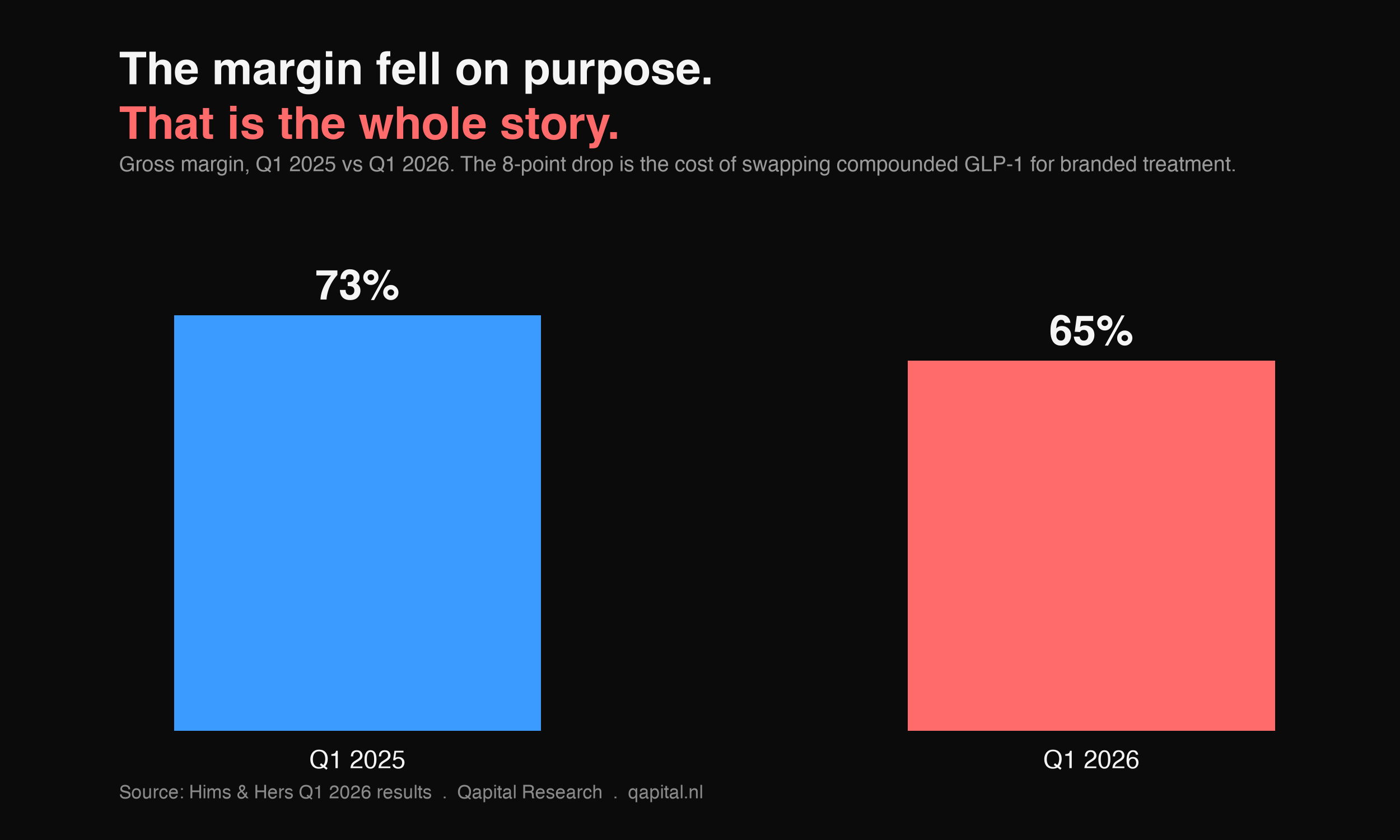
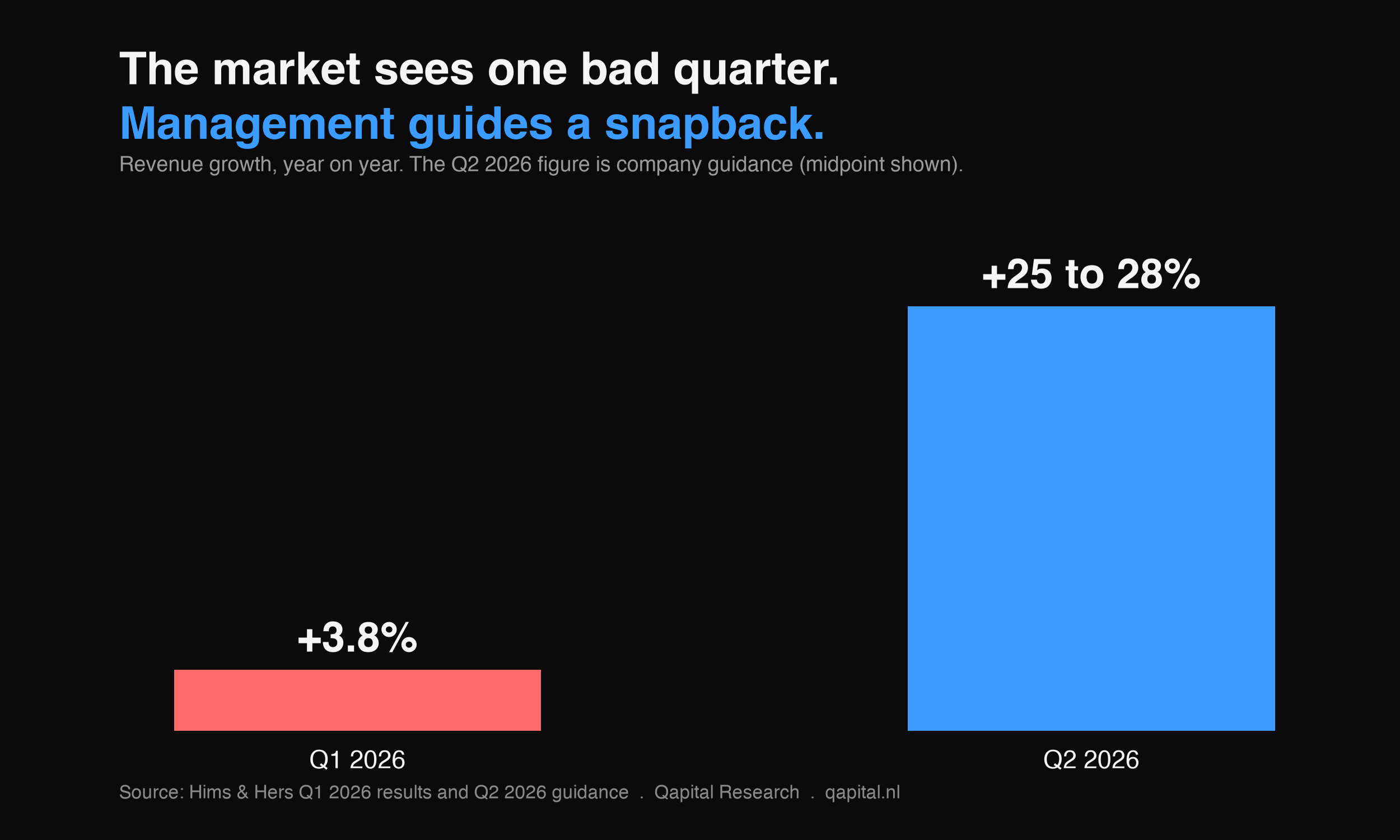
Revenue grew 3.8% year on year. A company the market had paid up for as a hypergrowth name delivered low single digits. Gross margin fell from 73% to 65%. The company swung from a $49.5 million net profit a year ago to a $92.1 million net loss. The stock is down roughly 51% from its high.
That is the picture the tape is pricing. It is also the wrong picture, and the reason is buried in the segment split.
US revenue fell 8%. International revenue grew 969%. And the margin did not collapse because the business broke. It collapsed because Hims deliberately killed its single highest-margin product.
The market is treating a choice as a catastrophe. That gap is where this article lives.
What Actually Happened: The Novo Break, and the Make-Up
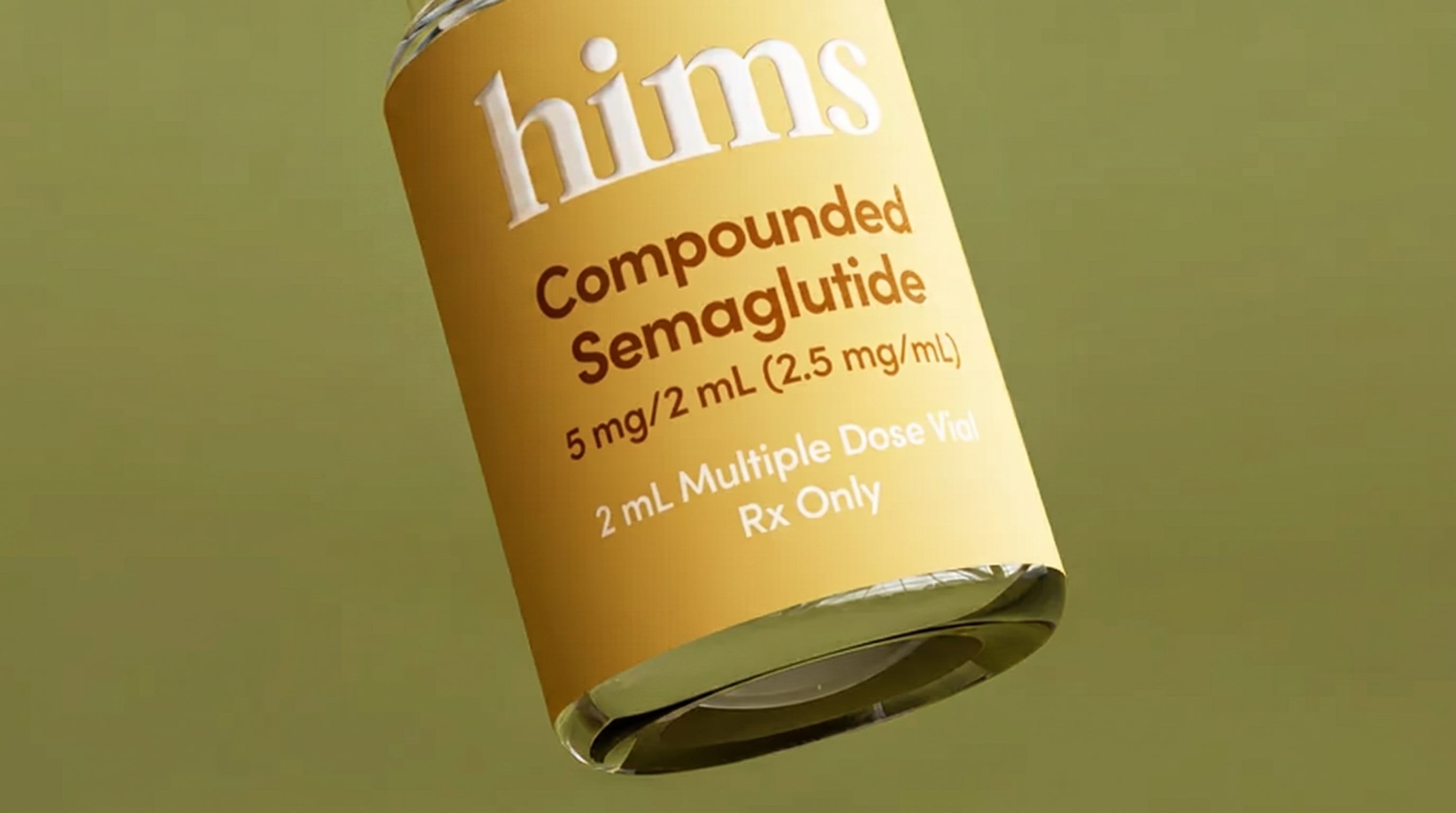
For most of 2024 and 2025, a large slice of Hims’ weight-loss revenue came from compounded semaglutide, a copy of Novo Nordisk’s Wegovy and Ozempic that pharmacies were allowed to make while the branded drugs were in official shortage. It was cheap to produce and sold at scale. It was also extraordinarily high margin, and it was always living on borrowed time.
The timeline matters. In June 2025, Novo Nordisk terminated its short-lived partnership with Hims, accusing the company of “illegal mass compounding.” For most of a year the two were adversaries. Then, on March 9, 2026, they made up. Hims agreed to stop promoting compounded GLP-1 and to move patients onto FDA-approved Wegovy and Ozempic at standard pricing. Novo dismissed its patent-infringement lawsuit, though it reserved the right to refile.
That re-partnering is exactly what you are seeing in the Q1 numbers. Branded GLP-1 carries a fraction of the margin that compounded GLP-1 did. So revenue mix shifted, gross margin dropped from 73% to 65%, and reported growth slowed while the company swallowed roughly $33.5 million of restructuring on top.
Here is the part the sell-off ignores: Hims chose this. It walked away from its most profitable product to get on the right side of the regulator and the branded manufacturer. You can argue the timing or the execution. You cannot call a voluntary move to legitimacy the same thing as a business deteriorating underneath you. The market is pricing them as identical.
The Behavioral Trap: Pricing the Trough as the Trend
This is a crowd pricing a nightmare, and the mistake has a name in behavioral finance. Call it extrapolation, or recency bias. When a high-flier stumbles, investors flip in an instant from pricing perfection to pricing collapse, and they do it by grabbing the most recent, most salient data point and drawing a straight line through it. One ugly quarter becomes the new permanent trend. Short interest sits at roughly 30% of the float, a crowded bet that the decline is permanent.
The discipline is to ask whether the salient quarter is the signal or the noise. Here the company itself is telling you it is noise: management guided Q2 2026 revenue to $680 to $700 million, which is 25% to 28% growth, a sharp reacceleration from the 4% the market just recoiled at. They guided full-year revenue to $2.8 to $3.0 billion and full-year adjusted EBITDA to $275 to $350 million.
That is management drawing the line through a different point than the crowd. One of them is wrong. The question this article has to answer is which, and why.
The Business Underneath the GLP-1 Noise
Strip out the weight-loss drama and look at what Hims actually is, because the GLP-1 story has come to dominate a business that is much broader than one molecule.
Hims is a subscription telehealth platform. A customer comes in for one problem, hair loss, sexual health, skin, anxiety, weight, and gets a consultation, a prescription, and a recurring monthly shipment, all inside one vertically integrated system that Hims controls end to end. The economics that matter are recurring revenue and the cost of keeping a subscriber, not the margin on any single drug. The company ended Q1 with about 2.6 million subscribers, up 9% year on year, and it is increasingly cross-selling those subscribers into more than one category.
Two facts get lost in the noise. First, the platform is cash-generative: operating cash flow was positive at about $89 million in the quarter, even as the GAAP line showed a loss, and the company has a $250 million buyback authorized since late 2025. This is not a cash-burning story. Second, there is a genuine international build-out, though it has to be read honestly. Rest-of-world revenue grew 969% year on year, but off a tiny base of about $7 million, and the jump is acquisition-driven rather than organic: it reflects the ZAVA (Western Europe) and Livewell (Canada) deals consolidating over the past year, not underlying momentum. The larger international bet, the roughly $1.15 billion Eucalyptus acquisition, only closed on June 2, 2026, so it adds nothing to these numbers yet and is excluded from current guidance; it is a future driver, not a reported one. Hims has also launched generic semaglutide in Canada, which is genuinely generic rather than compounded, made possible by a quirk in which Novo let its Canadian patent lapse early. That door is open in Canada specifically, not in the US, where semaglutide stays protected for years.
The durable asset is the customer relationship and the data that comes with it, not the copy of someone else’s drug. That is the part the “broken story” framing completely misses.
Andrew Dudum and the Bet on Going Legitimate
Hims is founder-led, and the founder is central to both the bull case and the risk.
Andrew Dudum built Hims into one of the few consumer healthcare brands that people actually recognize and trust, in a category, telehealth, that is mostly faceless. He is aggressive, promotional, and very visible, and he made the call that defines this whole episode: trade the fat, fragile, compounded-GLP-1 margin for a slower but legitimate branded relationship with Novo. That is a founder choosing durability over the next quarter’s optics, which is the behavior you want, even when the market punishes it.
The same traits are the risk. A promotional founder who pushed hard into legally grey compounding is a judgment question, not just a growth story, and the Novo dispute is evidence on both sides. Alignment is genuine, Dudum has real skin in the game. The caveat is that the qualities that built the brand are the same ones that walked it into a public fight with its most important supplier.
The Catalyst: Q2 Is the Line in the Sand
Most contrarian setups make you wait years to find out if you were right. This one resolves in weeks.
Everything in this thesis comes down to a single, testable number: does Q2 2026 deliver the guided 25% to 28% reacceleration. If it does, the “broken story” reading is falsified in public, on a date, and the stock re-rates off a trough multiple. If it misses, the bears were right that the compounded-GLP-1 air pocket was masking a slower, lower-margin business, and the stock deserves to fall further.
That is rare and valuable. It means you are not buying a vague hope; you are buying ahead of a hard, near-term test with a clearly defined pass mark. It also means position sizing and the entry matter, because the catalyst cuts both ways.
The Competition Picture
The honest weakness in the bull case is the molecule. Hims has no moat on the branded GLP-1 drug itself. It is reselling Novo’s product, and the competitive field around it is getting more crowded, not less. The FDA approved Eli Lilly’s oral GLP-1 pill, orforglipron (branded Foundayo), on April 1, 2026, which lowers the friction of weight-loss treatment industry-wide, and Novo is not exclusive to Hims; it also works with Ro, WeightWatchers, and LifeMD.
So if you frame Hims as a weight-loss drug company, it is a price-taker in a commoditizing market, and that framing supports the bears.
There are real risks beyond the molecule, and an honest buy case has to carry them. Hims is a direct-to-consumer business that runs on paid marketing, so if customer-acquisition costs rise as competition intensifies, the subscription math gets harder, and the company has historically spent heavily to grow. Retention is the variable that actually decides the model, and weight-loss customers in particular may prove less sticky than the hair and skin base once they reach their goal. The whole category sits under tightening telehealth prescribing scrutiny that reaches well beyond GLP-1. And it is fair to ask whether GLP-1 demand is a structural shift or a wave that crests. None of these is disqualifying, but they are why the bears are not foolish, and why this is a position to size rather than a certainty.
The better frame, and the one the durable value sits in, is that Hims is a multi-category consumer subscription business that happens to also sell GLP-1. Its edge is not the drug. It is the brand, the customer acquisition machine, the personalization data, and the cross-sell across hair, skin, sexual health, mental health, and weight. Those are real and hard to replicate at consumer scale. The investment question is whether you are paying for the commodity reseller or the consumer platform. At today’s price, you are paying for the former and getting an option on the latter.
Quality Assessment
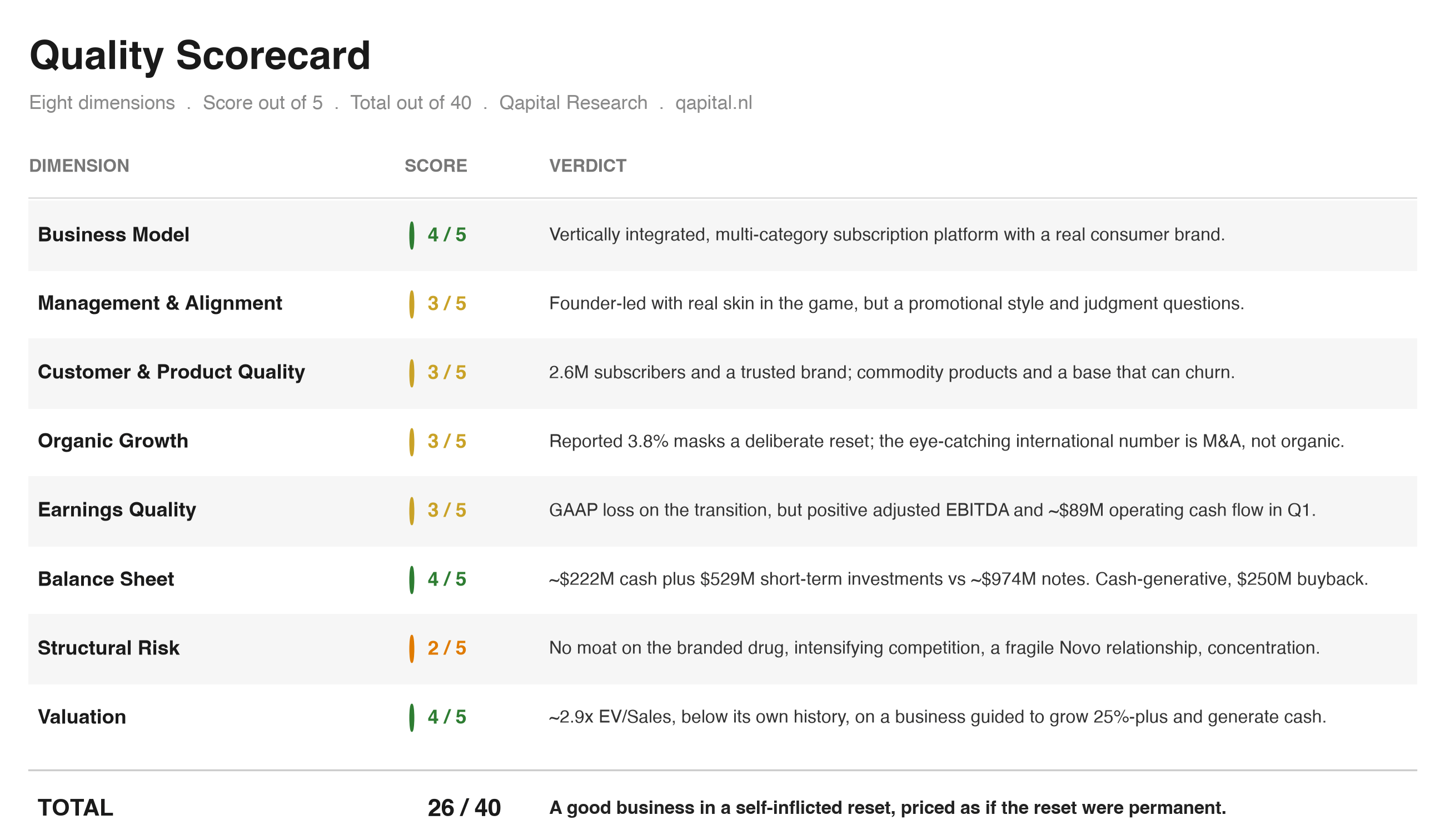
Business Model: 4/5
A vertically integrated, multi-category subscription platform with recurring revenue and a genuine consumer brand. Held back by low switching costs on any single drug and heavy reliance on a weight-loss category it does not control.
Management and Alignment: 3/5
Founder-led, with real skin in the game and a credibility-building decision to go legitimate. One point off for the promotional style and the judgment questions raised by the compounding episode and the Novo fight.
Customer and Product Quality: 3/5
About 2.6 million subscribers and a trusted brand in a faceless category, with growing cross-sell. Offset by commodity products and a customer base that can leave when a cheaper or more convenient option appears.
Organic Growth: 3/5
Reported growth of 3.8% is ugly. It masks a deliberate reset, and management guides a reacceleration to 25% to 28% in Q2. But the eye-catching international number is acquisition-driven, not organic, so the strength of the underlying organic engine is exactly what remains unproven.
Earnings Quality: 3/5
A GAAP loss this quarter driven by the transition and restructuring, but positive adjusted EBITDA and positive operating cash flow of about $89 million in the quarter. Cash-generative, but the margin structure post-pivot is not yet proven.
Balance Sheet: 4/5
About $222 million in cash plus $529 million in short-term investments, against roughly $974 million of convertible notes, modest net leverage, cash-generative operations, and a $250 million buyback authorized. Comfortable for the plan.
Structural Risk: 2/5
No moat on the branded drug, intensifying competition including Lilly’s new oral pill, a fragile supplier relationship where Novo reserved the right to refile its suit, and concentration in a single hot category. Stacked and unresolved.
Valuation: 4/5
About 2.9x EV/Sales, below the company’s own history, on a business guided to grow more than 25% and generate positive cash flow. Not a deep-value screen, but a reasonable price with the pessimism doing the heavy lifting.
Total: 26 / 40
Read plainly: a good business going through a self-inflicted, visible reset, priced as if the reset were permanent. The strength is the platform and the price; the weakness is the lack of a moat on the molecule and the unproven post-pivot margin. The asymmetry runs in the buyer’s favor.
What the Numbers Say About Price
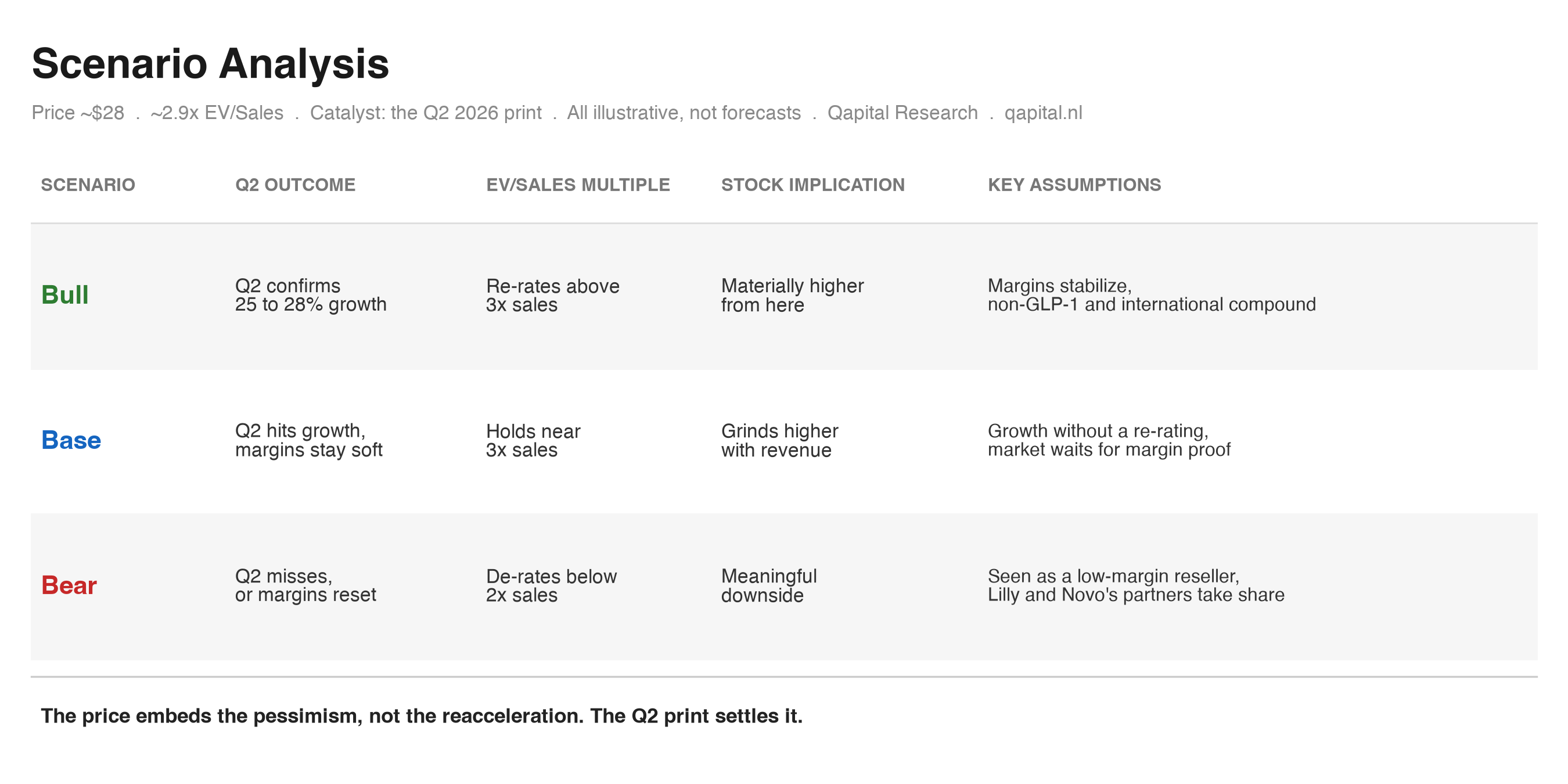
With earnings distorted by the pivot, the honest anchors are EV/Sales and the EBITDA guide, not P/E, where post-pivot estimates are so scattered (anywhere from roughly 50x to 250x) that the metric is useless right now. Three scenarios.
Bull case. Q2 confirms the 25% to 28% reacceleration, branded GLP-1 margins stabilize as the mix matures, the non-GLP-1 categories and international keep compounding, and full-year EBITDA lands in the upper half of the $275 to $350 million guide. The market stops pricing a broken story and re-rates the multiple back toward the company’s own history, well above 3x sales, on a larger revenue base. That is a materially higher stock from here.
Base case. Q2 hits the guided growth but margins stay compressed, because branded GLP-1 is structurally lower margin and the market wants proof before paying up. Revenue grows 25%-plus, the EV/Sales multiple stays near 3x while investors wait, and the stock grinds higher roughly in line with revenue. You make money on growth, not on a re-rating.
Bear case. Q2 misses the guide, or the margin reset proves permanent and Lilly’s oral pill plus Novo’s other partners take share. The market concludes Hims is a low-margin reseller, not a platform, and re-rates it below 2x sales. That is meaningful downside from here, with the GAAP loss giving the bears cover.
The point is the shape of the bet. At roughly 2.9x sales, below its own history, with a cash-generative model and a guided reacceleration, the price already embeds a great deal of the bear case. The bull case is not in the price. That is the asymmetry running the right way, and the Q2 print tells you within weeks which branch you are on.
The Bold Call
Hims & Hers did the responsible thing and got punished for it. It walked away from its most profitable product, a legally grey compounded drug, to get on the right side of the regulator and its most important supplier. The reward was one ugly transition quarter and a halving of the stock. The market, doing what it always does after a high-flier stumbles, took the worst recent data point and drew a straight line through it.
The business underneath is a cash-generative, multi-category consumer subscription platform with a real brand, 2.6 million subscribers, a young international business it is building out through acquisition, and management guiding a sharp reacceleration in the very next quarter. None of that looks like a broken story. It looks like a self-inflicted air pocket being priced as a permanent decline.
Our rating: BUY, contrarian. The price embeds the pessimism; it does not embed the reacceleration. The asymmetry runs in the buyer’s favor.
But this is not a buy-and-forget. The whole thesis rests on one testable claim, and you find out fast. The line in the sand is the Q2 2026 print and its 25% to 28% growth guide. Hit it, and the broken-story reading is falsified in public and the re-rating begins. Miss it, and the bears were right that the compounded-GLP-1 quarter was hiding a slower, lower-margin business, and the thesis is wrong. Size it accordingly.
The crowd is pricing the trough as the trend. We think the trough was a choice. Buy ahead of the proof, and let Q2 settle the argument.
Sources and Disclosures
This article is research and analysis, not financial advice. Qapital Research holds no position in Hims & Hers at time of publication.
Primary sources: Hims & Hers Q1 2026 earnings release and 8-K (filed May 11, 2026); company guidance for Q2 and full-year 2026 (Q2 revenue $680 to $700M and adjusted EBITDA $35 to $55M; full-year revenue $2.8 to $3.0B and adjusted EBITDA $275 to $350M); company disclosures on the March 9, 2026 Novo Nordisk re-partnering and the discontinuation of compounded GLP-1; Eucalyptus acquisition close (June 2, 2026).
Secondary sources: sell-side notes (BofA, JPMorgan, Canaccord price-target revisions, May to June 2026); reporting on the June 2025 Novo Nordisk partnership termination and the March 2026 settlement; FDA approval of Eli Lilly’s oral GLP-1 (April 1, 2026); market-data providers for price, market capitalization, short interest, and 52-week range as of early June 2026.
Note on figures: Revenue, margin, subscriber, cash, debt, EBITDA, and guidance figures are from the Q1 2026 earnings release (8-K filed May 11, 2026) and the company’s Q2 and full-year 2026 outlook. Price, market-capitalization, valuation, and short-interest figures are approximate, as of early to mid June 2026, and will move. The Q2 2026 result that this thesis hinges on had not been reported at the time of writing. Forward P/E is intentionally not used, as post-pivot estimates are too scattered to be meaningful; valuation is anchored on EV/Sales and the EBITDA guide. The Q1 international growth figure is acquisition-driven and should not be read as organic.
Qapital Research
Published June 2026